
Fact Checking a Misleading Iran War Meme
Using AI "Deep Background" from Mike Caulfield

We are living in surreal times, and our news feeds can be both perilous and important to watch. I shared a video update this evening for Heal Our Culture in which I attempted to process some of what is happening, including the sharing of misleading memes related to the new war the United States is waging against the nation of Iran. (Which started yesterday.) Here’s a summary of how I fact checked one of those memes today.
One of my former middle school teachers shared the meme on the left side of the image below on her Facebook page this afternoon.
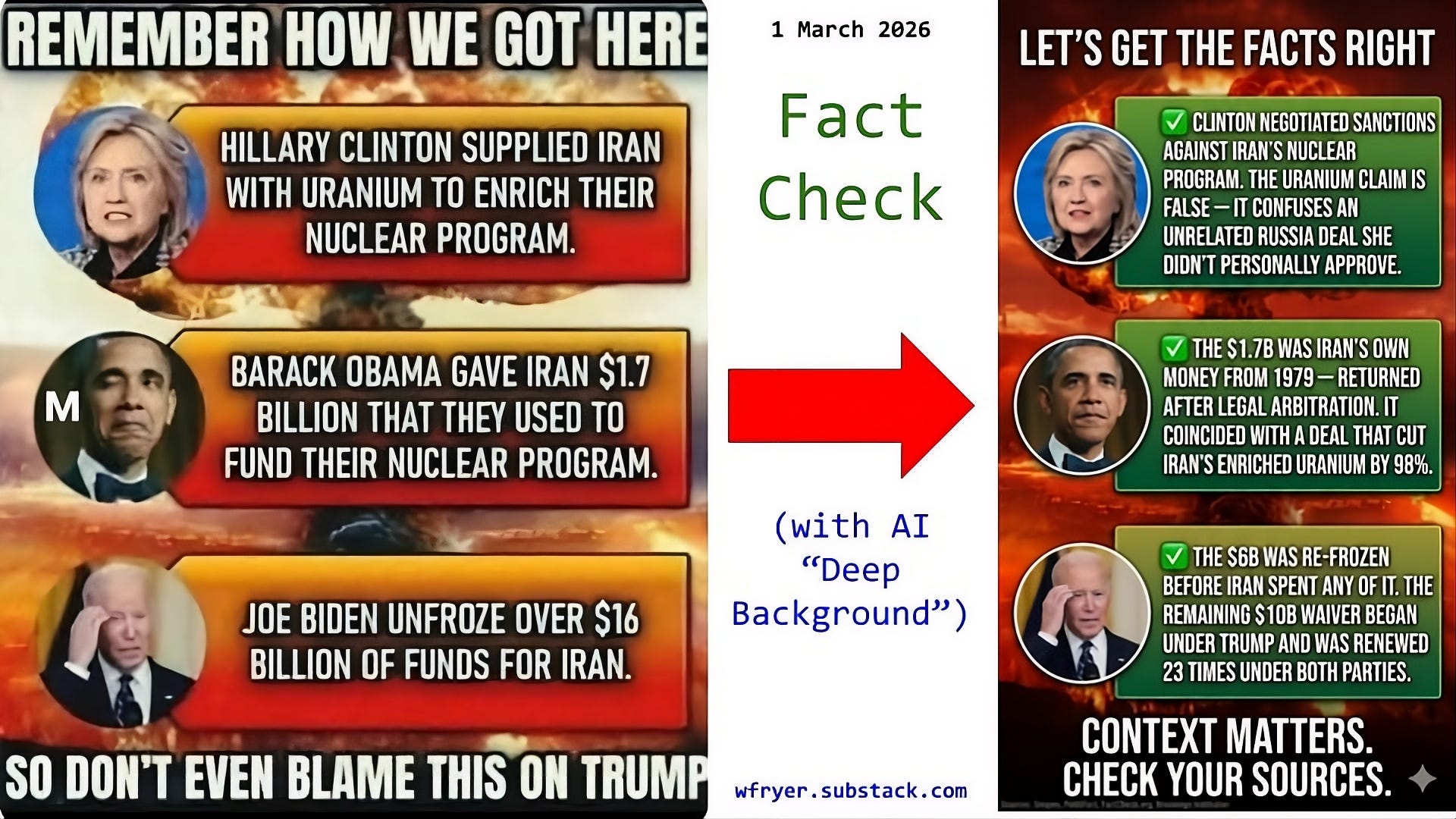
Using the techniques and lessons learned from the November 2025 Media Education Lab webinar, “Fact Checking with AI Superprompts,” I used Mike Caufield’s “SIFT Toolbox” or “Deep Background AI Superprompt” to fact check the multiple claims included in this meme.
You can access the results of that lengthy and thorough fact check via this link to the archived conversation with Claude Pro. Here are some of the highlights, shared under the subtitle, “Revised Summary (Corrected & Contextualized):”
This meme makes three distinct claims about Democratic politicians enabling Iran’s nuclear program. All three are either false or missing critical context.
The Clinton claim is false. Hillary Clinton did not supply Iran with uranium. As Secretary of State, she led efforts to impose the toughest-ever international sanctions on Iran, explicitly to prevent Iran from developing nuclear weapons (American Presidency Project). She later played a role in laying groundwork for the JCPOA, which allowed Iran to maintain limited, monitored enrichment. The meme appears to conflate this with the entirely separate “Uranium One” controversy — a debunked claim about uranium mined in the U.S. being sold to a Russian company, not Iran, via a unanimous nine-agency government approval process in which Clinton was one vote (PolitiFact; Wikipedia).
The Obama claim has a kernel of truth that is significantly distorted. The $1.7 billion transfer is real and was conducted in cash — a fact that drew genuine controversy at the time. But it was the return of Iran’s own money: $400 million Iran had deposited in a U.S. arms trust fund before the 1979 revolution, plus $1.3 billion in interest accumulated during decades of legal arbitration at The Hague (Brookings). There is no documented evidence Iran used those funds for nuclear development — and the payment coincided with JCPOA Implementation Day, when Iran’s enriched uranium stockpile was reduced by 98% and international inspectors gained unprecedented access (Center for Arms Control).
The Biden claim is the most nuanced: the $16 billion figure is technically assembled from real numbers, but it obscures more than it reveals. The $6 billion component was Iran’s own frozen oil revenues moved from South Korea to Qatar for humanitarian use, re-frozen after October 7 before Iran spent any of it. The ~$10 billion component is a sanctions waiver for Iraqi energy payments that was first issued in 2018 under President Trump and renewed approximately 23 times under both administrations (Snopes; FactCheck.org). No U.S. taxpayer funds were involved in either case.
You can watch a narrated video version of my explanation of this “AI superprompt fact check” starting at 4:28 of tonight’s video update for “Heal Our Culture.”
As I stated in that video, I’m not under any illusions that fact checks like this can re-orient or change the mind of people like my former middle school teacher who shared that meme… Her Facebook feed reveals she is deeply inside the MAGA media bubble.
HOWEVER, I do contend that having AI-powered fact checking superprompts like this can be a helpful and powerful way to conduct deep fact checks with memes and other media sources today.
I don’t think we’re going to “fact check our way out of polarization,” but I do think critical thinking, savvy fact checking and media literacy skills are essential for us to be informed, articulate and engaged citizens in our respective nations. Fact checking also DOES matter, even if it doesn’t change a specific person’s mind or perspectives.
That is the point Paul M. Barrett persuasively argues for in his January 27, 2025 article for TechPolicyPress, “Some Facts About Fact-Checking: Defending the Imperfect Search for Truth in an Era of Institutionalized Lying:”
But the widely accepted observation that even scrupulous fact-checking may not cause hardened partisans to change their minds on polarizing issues should not be over-interpreted as a reason to abandon fact-checking. That’s because changing people’s minds is the wrong criterion for judging whether fact-checking — or any fact-based journalism — is worth doing.
The point is not to transform Robert F. Kennedy Jr. into a pro-vaccine zealot. The point is to put facts out into the world in hopes that, in the long run and in the aggregate, more factual information will contribute to a healthier debate about important civic issues. Measuring the broader effects of contributing more solid facts to the information ecosystem is difficult, so it generally hasn’t been done by social scientists or anyone else.
However limited it may be, fact-checking sends a signal that there’s a distinction between facts and falsehoods and that everything is not up for grabs simply because powerful people say it is. Meta has scorned and stifled that signal. Others should not follow suit.
I hope you give “AI superprompt fact checking” a try soon.
If you’re interested in joining (or at least following along) with my wider advocacy for values like human rights and representative democracy (as well as media literacy) check out the links on my advocacy page. You also might check out the presentation I’ll share on Wednesday, “Reclaiming Our News Feeds,” for the February 2026 “THRIVE: United for Democracy and Global Action” conference.
It’s a great day to collaborate and work together with others to support positive changes in our communities and shared culture.