
Memes, Warfare, and Propaganda
Two Videos Worth Your Time

In my April 26 Media Literacy Roundup, I previewed our then-upcoming Media Education Lab webinar on “Memes, Warfare, and Propaganda” and promised a reflection afterward. This is that reflection. I was reminded about needing to share it because the latest CBS Sunday Morning episode, “Inside Iran’s online propaganda war,” covered nearly identical ground for a national television audience.
If you only have time for one, watch the CBS Sunday Morning piece first. (11 min) It is short, accessible, and frames the stakes clearly. Then, when you have time, dig into the full Media Education Lab webinar recording for the educator-focused version with additional examples, recommended resources, and breakout discussion notes.
Here is why both videos matter.
CBS Sunday Morning: Iran is Winning the Meme War
Ted Koppel’s reporting is a wake-up call. A few moments that landed hard for me:
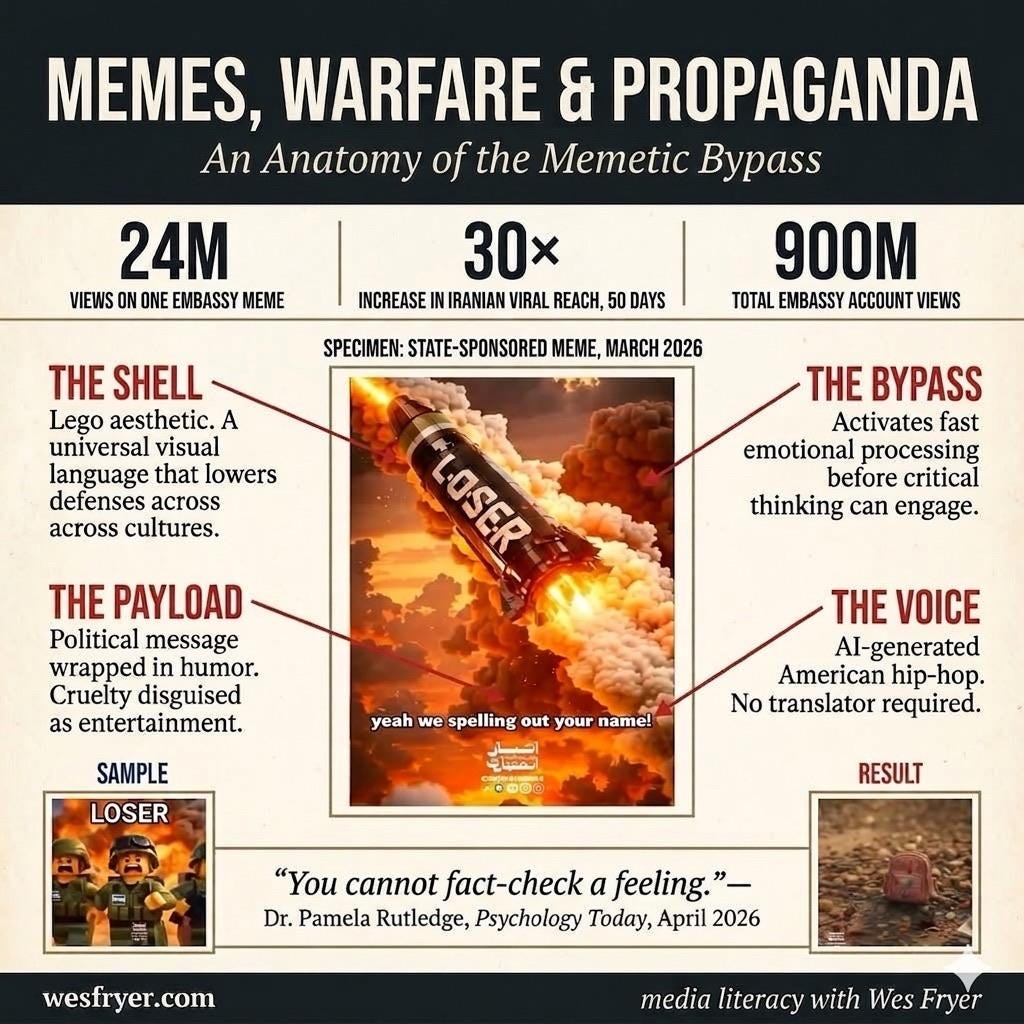
A single Iranian embassy meme drew 24 MILLION views. Diplomatic accounts do not normally do that.
Bret Schafer of the Institute for Strategic Dialogue documented a 30-fold increase in views and likes for Iranian X accounts in the 50 days leading up to the war, with nearly 900 million views across embassy and consulate accounts.
Iran’s “Explosive Media” team, interviewed in Tehran, explained why they chose Lego: “Lego is a universal language.” The polished American hip-hop voiceover on their videos? Almost certainly AI-generated.
Jamie Rubin, who ran the State Department’s Global Engagement Center, says the US has lost its footing in the information war. The unit specifically designed to counter foreign disinformation was eliminated by Congress in 2024.
The White House’s official response to CBS News was itself a meme. Read it for yourself in the segment.
Koppel’s takeaway: effective propaganda does not require that a charge be true. The mere suggestion that it might be is enough.
Media Education Lab Webinar: The Educator’s View
Our May 4, 2026 Media Education Lab webinar goes deeper into how educators should respond. Highlights:
A side-by-side tour of memes from US official accounts (the White House, DHS, Secretary Hegseth) and from Iranian-aligned creators like Explosive Media. Same toolkit. Different audiences. Different goals.
An introduction to the concept of the “mimetic bypass” from Dr. Pamela Rutledge’s April 2026 Psychology Today article. Memes activate our fast, emotional processing before slower critical thinking can catch up. You cannot fact-check a feeling.
A short Notebook LM summary video I created from all of our recommended resources for the session, which I think captures the through-line beautifully. (The link is in the webinar slides.)
Trusted voices worth following right now: Matthew Gault’s Angry Planet podcast and his writing for 404 Media. His March 27, 2026 piece, “Iran is winning the AI slop propaganda war,” is essential reading.
A reminder that none of us are immune from propaganda, and that training our own algorithms is a real risk when we go searching for this content. Use a separate account if you need to.
For educators, the mandate has shifted. Logical fact-checking is no longer enough. We need to teach students to recognize when nostalgia, humor, and gaming aesthetics are being weaponized to package policy as entertainment. Mike Caulfield’s SIFT web literacy framework remains my anchor for that work in my middle school media literacy classes.
Watch In This Order
First: CBS Sunday Morning: Inside Iran’s online propaganda war
Then: Media Education Lab Webinar: Memes, Warfare, and Propaganda
After you have watched both, please let me know what you think, and consider sharing this post with one other educator or friend in your life. The most powerful response to memetic warfare is a community of informed viewers.
AI Attribution: I drafted this post with Claude AI by Anthropic, working from the full transcripts of both videos and a sample of my recent writing. More of my AI experiments and use cases are shared on ai.wesfryer.com.